
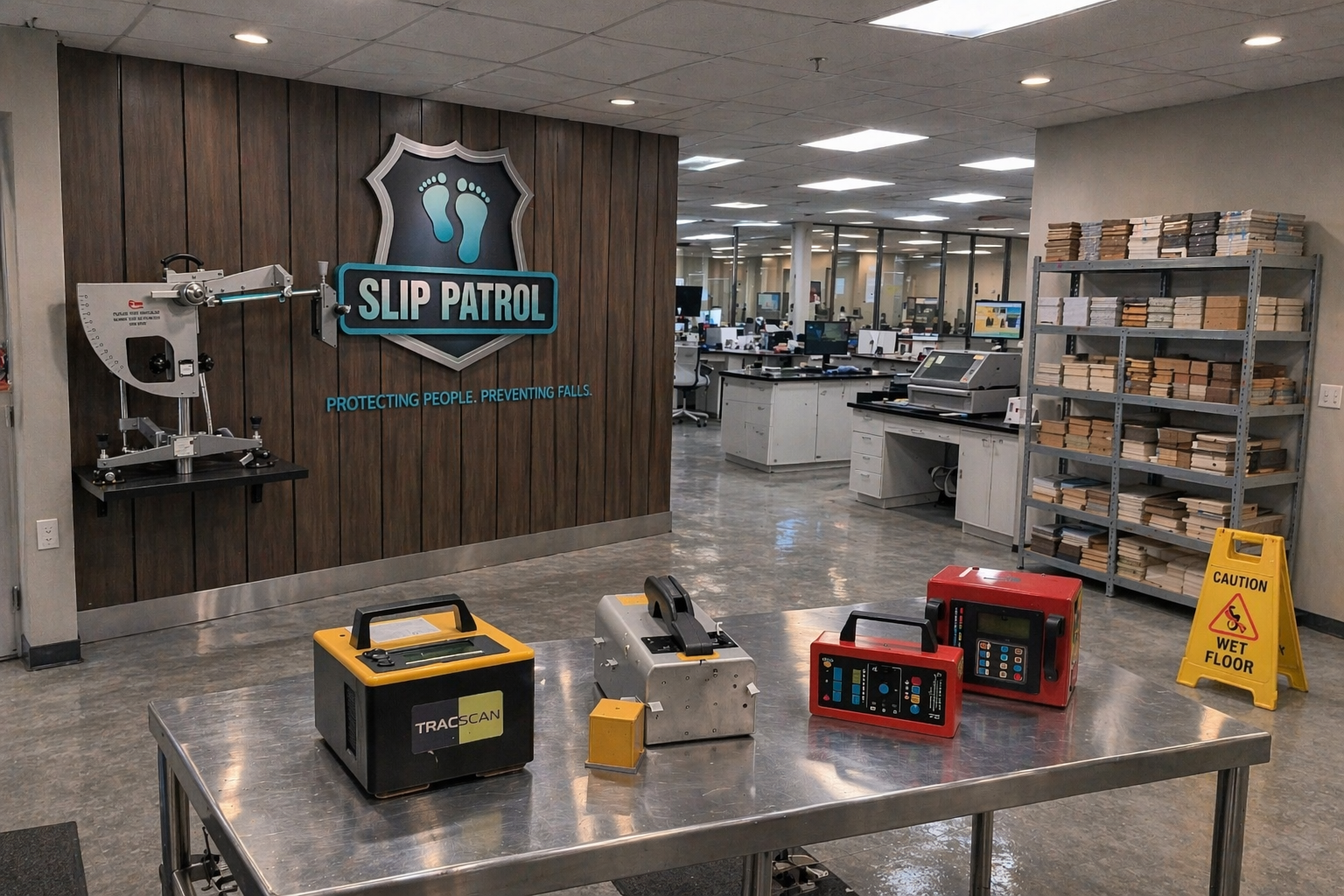
Slip Resistance Testing and Walkway Auditing
Professional Slip Testing & Walkway Auditing
Slip Patrol is a leading provider of slip testing and walkway auditing services across the United States, supporting attorneys and their clients with scientific, standards-based testing.
Our certified specialists (WACH) use National Floor Safety Institute (NFSI)–approved tribometers to measure the coefficient of friction (COF), including both Static Coefficient of Friction (SCOF) and Dynamic Coefficient of Friction (DCOF). These measurements determine how slippery a surface is under real-world conditions.
We perform testing and audits in accordance with industry-recognized standards:
NFSI B101.1: Wet SCOF testing
NFSI B101.3: Wet DCOF testing
NFSI B101.0: Walkway surface auditing
As NFSI-Certified Walkway Auditors, we provide detailed reports and defensible data that support litigation cases.
Slip Testing & Walkway Safety
Slip Testing Explained
What is slip testing?
Slip testing is the process of measuring how much traction a walking surface provides under specific conditions. It uses specialized equipment (tribometers) to evaluate whether a floor is likely to cause slips or falls. This testing provides objective data used by attorneys.
What is the coefficient of friction (COF)?
The coefficient of friction (COF) is a measurement used to evaluate how slippery or slip-resistant a surface is. Higher COF values generally indicate more traction, while lower values indicate a higher risk of slipping.
What is the difference between SCOF and DCOF?
Static Coefficient of Friction (SCOF): measures the force required to start movement between a shoe and floor
Dynamic Coefficient of Friction (DCOF): measures traction while a person is already in motion
Both measurements are important for understanding real-world slip risk.
What do the NFSI traction levels mean?
NFSI B101.1 and B101.3 sort measured values into three traction levels. Wet SCOF under B101.1:
High traction: 0.60 or higher
Moderate traction: 0.40 to 0.59
Low traction: below 0.40
Wet DCOF under B101.3:
High traction: 0.45 or higher on level surfaces and 0.50 or higher on ramps
Moderate traction: 0.30 to 0.44
Low traction: below 0.30
SCOF and DCOF measure different things, so values from one method are not compared with values from the other.
How is slip testing performed?
Slip testing is performed on-site using NFSI-approved tribometers. The surface is tested under controlled conditions to measure traction. Results are documented and provided in a detailed report that can be used in legal cases.
Can slip testing be used in legal cases?
Yes. Forensic slip testing is often used in slip-and-fall cases to evaluate whether a surface contributed to an incident. Proper documentation and testing methods can provide objective evidence for attorneys and insurance carriers.
What types of surfaces can be tested?
Slip testing can be performed on a wide range of surfaces, including:
Tile (ceramic, porcelain)
Concrete and coatings
Vinyl and LVT
Stone surfaces
Pool decks and splash pads
What does a slip resistance test report include?
A professional report typically includes:
Test results and measurements
Site conditions at time of testing
Photo documentation
Surface observations